
Jim Pepper - (1941-1992)
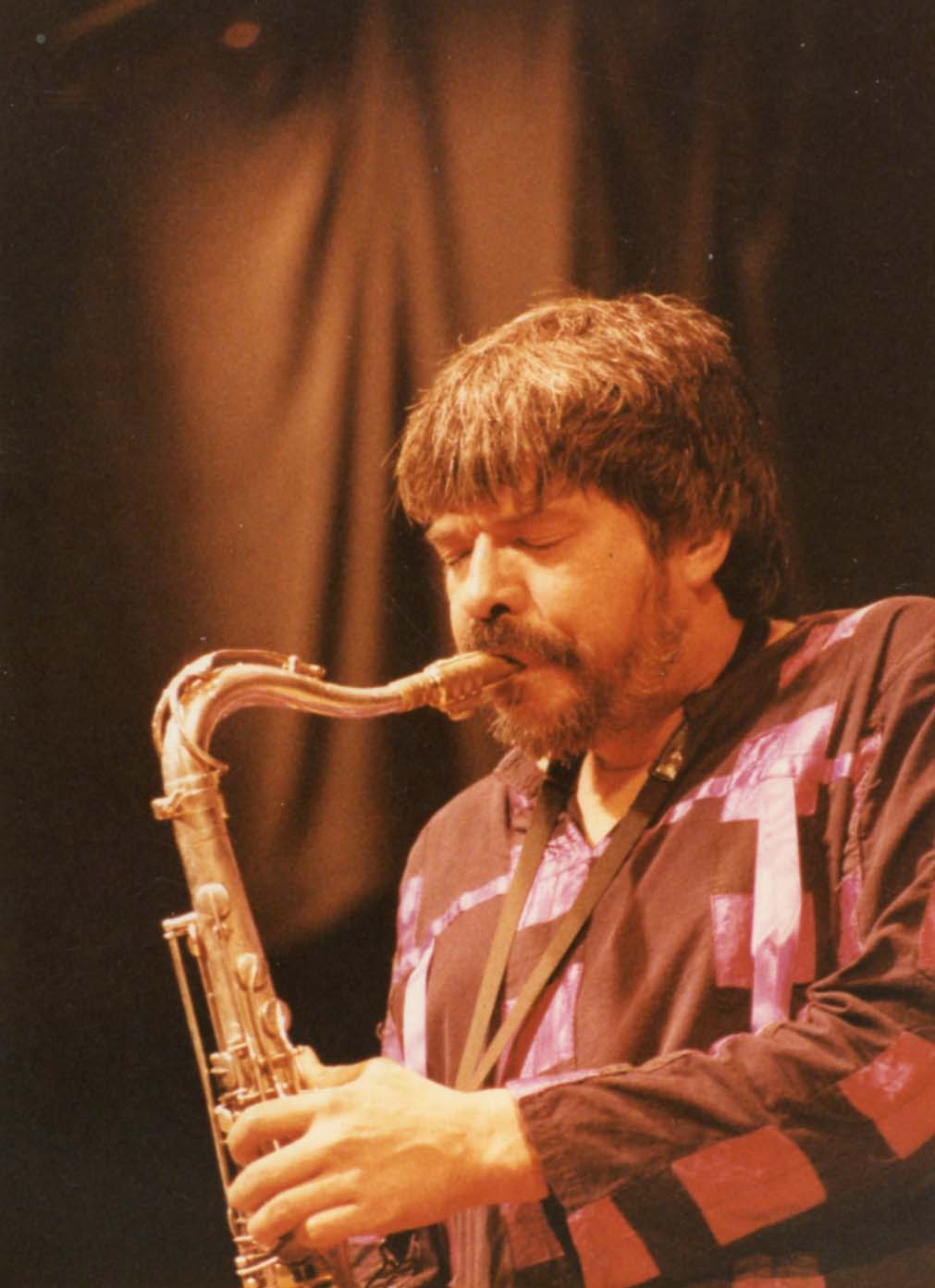
by Sean Aaron Cruz
James Gilbert (Jim) Pepper and two of his songs in particular, were the original inspirations for the concepts that led to the creation of the Speak/Sing NativeTM curriculum. Witchi Tai To ("Makes me feel glad that I'm not dead"), and Comin' and Goin' ("It's good where we've been and where we're goin'"), with their straightforward, positive messaging and the medicinal impact they have had on audiences for more than 55 years, led to the development of our strategy to impact both the dropout and suicide rates among young people.
The course is intended to give students reasons to want to come to school and engage in learning, and to never give up despite the pressures and concerns they feel.
Born in Salem, Oregon, he was a citizen of the Kaw Nation through his father and had Muskogee Creek ancestry through his mother. His Kaw Indian name, Hunga-che-Ada, translates to “Flying Eagle.”
Jim Pepper was a self-taught virtuoso on tenor and soprano saxophones and flute with prodigious improvisational skills, and a singer, songwriter, composer and band leader. He developed a unique sound on his horn that came to be described as his “Eagle Tone.”
Remembered primarily as a jazz musician, his musical horizon was much broader than that, exploratory and forward-looking, but based deep in Indian Country traditions and styles. Jim carved a path with his tenor sax that took him to New York City in 1964, where he co-founded The Free Spirits, credited with being the first band in music history to record jazz-rock fusion. Jim was fluent in jazz and rock and blues and a pioneer in World music, and he successfully merged all these vocabularies with Native church and powwow music.
“Jim Pepper’s music represents something that this museum has stood for from the very beginning. That is the wonderful connectedness between past and present, the gift of being able to move into media and forms of media that is not necessarily ours and making them ours in various powerful and important ways.” – Rick West, Executive Director, National Museum of the American Indian, 2007.
About Jim Pepper in quotes:
"Saxophonist Jim Pepper, a Creek and Kaw Indian, was an innovative jazz musician who made his mark in the United States and in Europe." – American Indian Community House, New York City
“His unique style fused Native American church music and powwow music with experimental jazz. Pepper is remembered for his contributions to the jazz scene and the Native music scene, and for expanding the perceptions and expectations for both genres.” – American Indian Community House, New York City
“I like Jim Pepper’s sound and the way he plays. He offsets Joe Lovano, who is more traditional, sort of coming from Coltrane. Pepper is kind of post-Coltrane.” – Paul Motian
“Pepper was a Flying Eagle. He also played with a certain Eagle Tone, I called it. A very upper-register atmospheric saxophone.... Jim Pepper’s music had a real vibration to it. His Native American roots and his personal journey through life came out in his horn.... The thing about Pepper that touched you was his clarity and his dynamic sound that came from his soul.” – Joe Lovano
“Jim opened up a lot of doors to take people to places that they had never been before, and we all have to work to keep his legacy alive and open more doors for young people, to inspire them to live their lives creatively and make a contribution to the world while we are here the way Jim did.” – David Amram
“Aside from his remarkable musicianship, Pepper stands out for having brought Native American musical ideas into jazz itself.” – Michael Palin, “Jazz and Native American Melodies”, Smithsonian Music
“Jim Pepper was one of the greatest Indigenous musicians of all time.” – Winona LaDuke
Professional Information
Pepper’s New York City-based band The Free Spirits (1965-67) is credited with being the first jazz-rock fusion band in music history. Jim Pepper also created an original fusion of traditional powwow, Native church and experimental jazz which also took in rock and blues styles.
- Jim Pepper’s Powwow World Premiere
- Up Where We Belong: Native Musicians in Popular Culture, National Museum of the American Indian
- Jim Pepper Lives by Bill Siegel
- Jim Pepper Legacy in Recorded Music: A Treasure Chest by Jim Olding for In Motion Magazine
- Jim Pepper facts for kids - Kids Encyclopedia Facts
(Posthumous recognition):
1999 - First Americans in the Arts Lifetime Musical Achievement Award
2000 - Native American Music Awards (NAMA) Hall of Fame
2002 - Gunther Schuller, (1996 winner of the Pulitzer Prize for Music) arranged, conducted and recorded Witchi Tai To, The Music of Jim Pepper in Cologne, Germany, with symphonic orchestra, jazz band and powwow singers
2005 - Oregon Legislative Assembly honored the extraordinary accomplishments and musical legacy of Jim Pepper with Senate Joint Resolution 31
2007 - Oregon Music Hall of Fame induction
2015 - Oregon Legislative Assembly honored Jim Pepper a second time with House Concurrent Resolution 8A
2023 - Jim Pepper's family home in Portland, Oregon, was placed on the National Register of Historic Places by the U.S. Department of the Interior for it's "contemporary cultural significance."
Don Cherry (Choctaw), Joy Harjo (Mvskoke Creek), Pete DePoe (Siletz), Pura Fe (Tuscarora/Taino), Ulali (Intertribal), Yellowhammer Singers (Ponca), Larry Coryell, Ra Kalam Bob Moses, Chris Hills, Joe Lovano, John Scofield, Paul Motian, Ornette Coleman, Mal Waldron, Caren Knight Pepper, Gordon Lee, Dan Balmer, Tom Grant, Ratso Harris, David Haskell, Ron Steen, J.B. Butler, Luciana Proaña, Nana Vasconcellos, Glenn Moore, Ralph Towner, Colin Walcott, Ed Schuller, Bill Bickford, Steve Johns, Mike Nock, Russell Ferrante, Dave Liebman, Bert Wilson, Keith Jarrett, Warren Gales, Calvin Hill, Dennis Springer, Billy Cobham, Chuck Rainey, Jerry Jemmot, David Friesen, Julian Priester, Dewey Redman, many others
Witchi Tai To (from Jim Pepper’s Powwow LP) 8:09 Audio 1971
Pepper’s first recording under his own name began with this chant and song
Witchi Tai To (Live at JazzFest Raab, Austria) 12:23 Live 1991
Jim Pepper performed one of his last concerts in Europe in 1991
Oregon ArtBeat (Oregon Public Broadcasting) produced this feature on Jim Pepper:
Jim Pepper Story, pt 1 (Oregon Art Beat) 8:20 Documentary 2007
Jim Pepper Story, pt 2 (Oregon Art Beat) 9:24 Documentary 2007
-------------------------------------------------
(Albums as leader):
1971 - Pepper's Pow Wow
1983 - Comin' and Goin'
1987 - Dakota Song
1988 - Art of the Duo with Mal Waldron
1988 - The Path
1989 - Flying Eagle: Live at New Morning, Paris
1990 - Remembrance
recorded 1991, issued 2003 - Polar Bear Stomp
recorded 1991, issued 2006 - Afro Indian Blues with Amina Claudine Myers Trio
(Albums as founding band member):
1967 - The Free Spirits, Out of Sight and Sound
recorded 1967, issued 2011 - The Free Spirits - Live at the Scene
1969 - Everything Is Everything with Chris Hills, Everything Is Everything
(Albums as featured soloist):
With Bob Moses, Devotion, recorded 1967, released 2013; Love Animal, 1968; When Elephants Dream of Music, 1983
With Sandy Hurvitz, Sandy's Album Is Here At Last, 1967
With Peter Walker, Second Poem to Karmela, 1968 (Pepper plays flute)
With Larry Coryell, Coryell, 1969 (Pepper plays flute)
With The Fugs, The Belle of Avenue A, 1969
With Cam Newton, Welcome to the Aliens, 1979
With Archie James Cavanaugh, Black and White Raven, 1980
With Gordon Lee, Land Whales in New York, 1982
With Charlie Haden Liberation Music Orchestra, The Ballad of the Fallen, 1983
With Paul Motian, The Story of Maryam, 1984; Jack of Clubs, 1985; Misterioso, 1987
With Nana Simopoulos, Wings and Air, 1986
With Ray and the Wolf Gang, The Blues Can’t Turn You Loose, 1987
With Marty Cook, Nightwork,1987; Red, White, Black & Blue, 1987.
With Mal Waldron: Remembering the Moment, 1987; Quadrologue at Utopia, 1989; More Git’ Go at Utopia, 1989
With Christopher Spendel, Ron McClure, Reuben Hoch, West End Avenue, 1989;
With the Claudine François Trio, Camargue, 1989;
With the World Music Orchestra, East West Suite, 1990
With Tony Hymas, Oyaté, 1990
1962-1992
Jazz, free jazz, jazz-rock fusion, rock, folk, traditional Native American
Musician, singer, songwriter, composer, bandleader
Flute, Saxophone
Video
Eagle Tone - Jim Pepper
Additional Information:
Recording by Mal Waldron Quartet, Quadrologue at Utopia Album
Jim Pepper induction to Native American Music Awards Hall of Fame - Jim Pepper, Floy C. Pepper, Caren Knight Pepper
Additional Information:
Students at 3:19:00 – Jim Pepper section starts at 3:20:30
Witchi Tai To - (from Jim Pepper’s Powwow LP)
Additional Information:
Pepper’s first recording under his own name began with this chant and song.
JIm Pepper Story, pt. 1 (Oregon ArtBeat) - Jim Pepper, Floy C. Pepper, Jim Pepper Henry, Caren Knight Pepper, Sean Aaron Cruz
Additional Information:
Band members include Caren Knight Pepper (vocals), Gordon Lee (piano), J.B. Butler (guitar), Glenn Moore (bass), Carlton Jackson (drums), Luciana Proano (dance).
Jim Pepper Story, pt 2 (Oregon ArtBeat) - Jim Pepper, Floy C. Pepper, Jim Pepper Henry, Caren Knight Pepper, Sean Aaron Cruz
Additional Information:
Band members include Caren Knight Pepper (vocals), Gordon Lee (piano), J.B. Butler (guitar), Glenn Moore (bass), Carlton Jackson (drums), Luciana Proano (dance).
Tribal Information
Kaw Nation
also known as "Kaw"
Kaw Nation (People of the Southwind)
“The Kaw Nation derived its name from the Siouan aca, ‘south wind,’ a reference to the tribe’s role in war ceremonials, using the power of the wind when recognizing warriors. Among the many variations of the name given by French traders and other Europeans were ‘Kanza’ or ‘Kansa.’ By the mid-18th century, the ‘Wind People’ were the predominant tribe in what became the state to which they gave their name (Kansas). Their territory extended over most of present-day northern and eastern Kansas, with hunting grounds extending far to the west.” (Source: tribal website)
Kaw Nation Celebrates Major Step in Return to Kansas 2:23 Official 2014
After more than 140 years, the Indians of the Kaw Nation are dancing again in their homeland of Kansas. The tribe held ritual dances Saturday south of Council Grove.
Kaw nation's ties to Kansas – KSNT News 3:47 Official 2014
Kaw Nation reclaims prayer rock exhibited for nearly 100 years in honor of white settlers 2023 "Twenty-four ton quartzite boulder headed to memorial park in Council Grove.”
Article 6 of the U.S. Constitution (the Supremacy Clause)
“This Constitution, and the Laws of the United States which shall be made in Pursuance thereof; and all Treaties made, or which shall be made, under the Authority of the United States, shall be the supreme Law of the Land; and the Judges in every State shall be bound thereby, any Thing in the Constitution or Laws of any State to the Contrary notwithstanding.”Artist Website: https://jimpepperlives.wordpress.com/
Wikipedia: https://en.wikipedia.org/wiki/Jim_Pepper