
Copy of Lesson 1: Native American Oregon Musicians
Lesson Overview
This lesson will allow for students to get an in depth look at prominent Indigenous musicians who are from the state of Oregon. This lesson will highlight musicians affiliated with some of the nine federally recognized tribes of Oregon as well as Native people who are affiliated with Indigenous communities outside of the state, but still call Oregon home. Within the main activity of the lesson, the students will get a biography of the musician/artist as well a sample of the music style they perform in. Alongside the sample music, the students will have the chance to see lyrics/music of the sample and have their first glimpse into songwriting. This will come in handy for the other lessons in the unit.

Materials to Download
Opening Activity
Oregon Musicians
Have students pull out a piece of paper or pull up a word/google doc and have them respond to the following questions:
- How many musicians can you think of that come from Oregon?
- Can you name any Native American musicians who come from Oregon
- Do you think the place where someone comes from has an impact on the way they create music?
With each of these questions, encourage students to think of anyone in their lives and what they have heard in music. Can be relatives, local bands, etc.

Oregon Native American Musicians Biographies and Listening Activity
√ Distribute Thinking Organizer #1
This thinking organizer will allow for students to listen and react to the videos and stories of Indigenous Oregonians. After each biography and listening, allow some time for students to take notes and write down their thoughts with the guiding questions.
- Have students listen to some or all of the musician listed below.
- After listening to each musician/artist, have students pair up and discuss what they learned about the artist.
- Have them test each other on the various facts about the artist.
- Additionally, have them explain how the music made them feel and if they could figure out the meaning of the type of performing art that was expressed in the video.
Please note: In each of the biographies below, there will be a picture of the musician/artist and bulleted key points about them. You will also find video links of the artist performing.
Please take into consideration the amount of time there is in the class session and choose how many artists to showcase. You may want to have the students help in choosing who to listen to.
Pete “Last Walking Bear” DePoe
Confederated Tribes of Siletz Indians
Have students really try to listen to Pete’s drumming and have them describe it. Talk about how the drums push the song in a fast tempo. The drums interact with each instrument and play off one another.
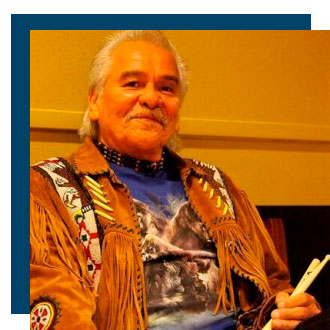
Redbone – The Witch Queen of New Orleans (1971) performed at Olympic Theater, Paris, France
- Pete DePoe, an enrolled member of the Confederated Tribes of Siletz Indians, was the original drummer of the seminal Native American band Redbone (1969-1972) and appears on five of its albums.
- The city of DePoe Bay, Oregon, bears his family name. His Indian name is Last Walking Bear.
- Pete was also the drummer in several configurations of Jim Pepper’s bands over the years, performing at concerts and festivals, celebrations and social justice rallies from coast to coast, including “The Night of the First Americans” at the Kennedy Center in Washington, D.C. Jim Pepper was the Music Director for the event.
- In 2017, after living in Europe for many years, Pete returned to Oregon to live on the Siletz Reservation. He stayed in the Jim Pepper House in Portland for a week on his way to Siletz, where he had many fond memories of his old friend and bandmate. “We also played together at the 100th anniversary of the Chemawa Indian School in Salem, Oregon in 1980. This is interesting when I think about that because I did not like that school when I attended there back in the 1950s…his legacy is amazing…I’m proud to say that I played with Jim Pepper, but more importantly, he was my friend and I loved him.” – Pete DePoe, 2017
- While he was in Portland, Pete appeared as a guest on David Liberty’s Native Nations cable TV show, after which a group of students from the Native American Youth and Family Center (NAYA) sang a song in his honor.
Milton “Quiltman” Sahme
Confederated Tribes of Warm Springs
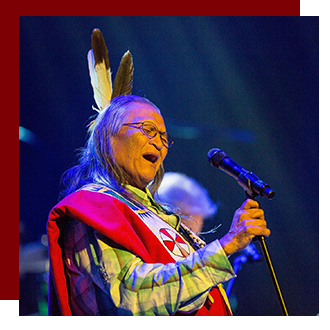
Quiltman Sahme of the Confederated Tribes of Warm Springs is recognized across Indian Country as a traditional singer, percussionist and songkeeper with countless traditional melodies in his music.
- Quiltman Sahme of the Confederated Tribes of Warm Springs is recognized across Indian Country as a traditional singer, percussionist and songkeeper with countless traditional melodies in his music.
- He toured extensively with John Trudell and his band Bad Dog, performing many hundreds of concerts across North America and Europe, and recording 17 albums over a period of 35 years.
- He has performed with Jesse Ed Davis, Bonny Raitt, Jackson Browne, Willie Nelson, Danny O’Keefe, the Pines, Blackbird and many others.
- Quiltman continues to perform and record, most recently featured on Blackbird’s album Talk About the NDN.
- He lives at Simnasho on the Warm Springs Reservation, where he owns Quiltman’s Coffee House.
Acosia Red Elk
Confederated Tribes of Umatilla Indian Reservation
Acosia Red Elk is an enrolled member of the Umatilla Tribe from the northeastern Oregon territory and a 2024 Doris Duke Artist Award recipient.
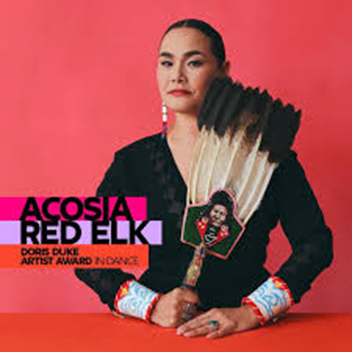
- Acosia Red Elk (Pendleton, OR) is an enrolled member of the Umatilla Tribe from the northeastern Oregon territory and a 2024 Doris Duke Artist Award recipient.
- She is a 10-time World Champion Jingle Dancer and world-renowned performing artist. She is also an international yoga instructor, snowboarder, glass artist, cultural teacher and wellness advocate.
- She is known for public speaking and storytelling, tribal dance performance, indigenizing fitness, teaching yoga through a tribal lens and instructing powwow dance to tribal youth across Turtle Island.
- Acosia travels the world performing and sharing cultural knowledge, movement and meditation. She is passionate about using yoga and universal movement as a way to heal from historical and intergenerational trauma.
- She created Powwow/Yoga, a fusion practice that braids together tribal dancing and yoga for a well-rounded workout with an Indigenous approach to wellness. Acosia leads classes with a seventh generation approach, teaching that all actions should be taken with a sustainable mindset to protect what is sacred.
- She is an advocate for health and wellness and encourages all people on earth to recognize the Indigenous knowledge within them so that they can continue to build bridges and protect earth’s resources for future generations.
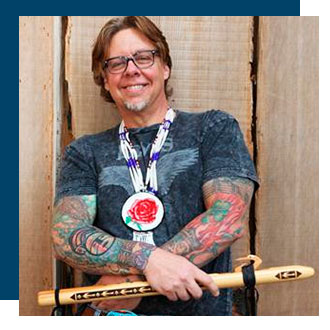
Jan Michael Looking Wolf
Kalapuya – Confederated Tribes of Grand Ronde
Jan Michael Looking Wolf is an enrolled Kalapuya Tribal Elder of the Confederated Tribes of Grand Ronde who lives within his indigenous homelands in Oregon and speaks his tribal language.
- An enrolled Kalapuya Tribal Elder of the Confederated Tribes of Grand Ronde who lives within his indigenous homelands in Oregon and honored Army Veteran, Jan Michael Looking Wolf is a world renowned Native American Flute musician and educator.
- He shares his powerful message of the tradition of ‘ONE HEART’. In short, it is a universal truth that everyone is equal regardless of the color of our skin, tribal affiliation, language we speak, income, gender, faith, nationality or personal beliefs. ‘ONE HEART’ is the recognition of Unity through Diversity.
- Jan Michael is the great grandson of Santiam Kalapuya Tribal Chief Joseph Sangretta, who was a signer of the Willamette Valley Treaty.
- Jan speaks his Tribal language and stays closely involved with the Tribal communities.
James Edmund Greeley
Warm Springs, Wasco, Nez Perce, & Hopi
James Edmund Greeley lives on the Warm Springs Reservation in Central Oregon. His ancestry is Warm Springs, Wasco, Nez Perce and Hopi. He plays Native flutes and bone whistles, performing in a wide variety of settings.
- James Edmund Greeley lives on the Warm Springs Reservation in Central Oregon. His ancestry is Warm Springs, Wasco, Nez Perce and Hopi.
- He plays Native flutes and bone whistles, performing in a wide variety of settings.
- His 2017 cd Before America won Best Traditional Recording at the Native American Music Awards. The songs range from contemporary traditional to those reaching back thousands of years on these lands and in these rivers.
- For example, no single place in Oregon is arguably more important than Celilo on the Nche’ Wana (Columbia River). The historic falls were flooded by The Dalles dam in 1957, destroying a way of life that had thrived for more than 12,000 years, the center of a vast trading network. Celilo Village remains the oldest continuously-occupied settlement in North America.
- James reached back and recorded these two songs to begin his album.
Scott Kalama (Blue Flamez)
Confederated Tribes of Warm Springs
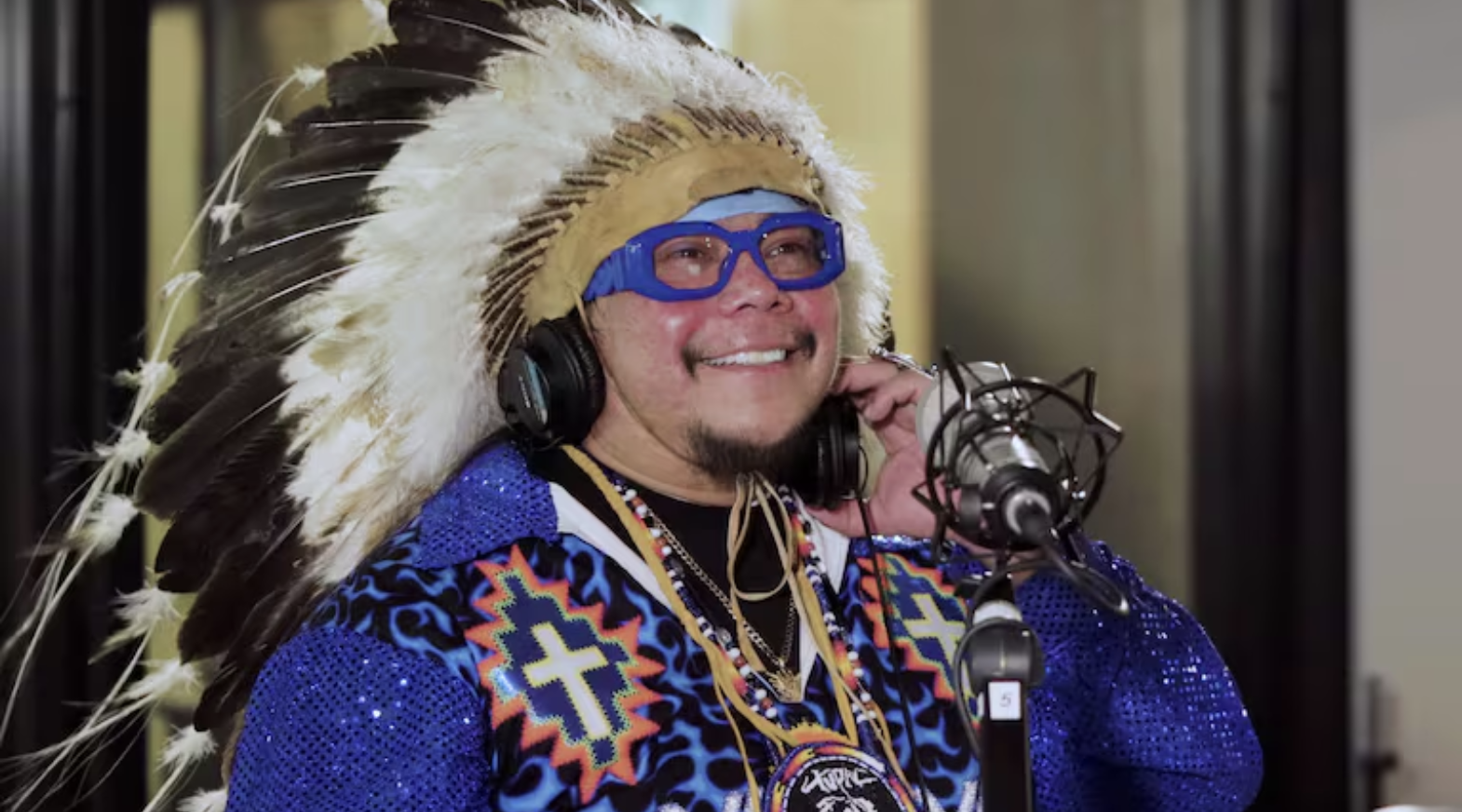
Scott Kalama, also known as hip hop artist Blue Flamez, is an enrolled member of the Confederated Tribes of Warm Springs. He works as a certified suicide prevention specialist with Warm Springs Prevention Services.
- Scott Kalama, also known as hip hop artist Blue Flamez, is an enrolled member of the Confederated Tribes of Warm Springs.
- He works as a certified suicide prevention specialist with Warm Springs Prevention Services.
- In 2016, Scott won Best Music Video honors at the Native American Music Awards for Rez Life and several nominations in various categories since then.
- In January 2024, he was awarded a two-year $150,000 Fields Artist Fellowship from Oregon Humanities and Oregon Community Foundation.
Rick Bartow (1946-2016)
Mad River Band of the Wiyot Tribe
Rick Bartow was an enrolled member of the Mad River Band of the Wiyot Tribe, whose homelands lie in Humboldt County, California. Born in Newport, he made his home in Oregon for much of his life.
We Were Always Here – Rick Bartow
- Rick Bartow was a member of the Mad River Band of the Wiyot Tribe, whose homelands lie in Humboldt County, California. Born in Newport, he made his home in Oregon for much of his life.
- Rick sang and played guitar, performing at the National Museum of the American Indian among other places, but it is as a painter and sculptor that he made his mark as an artist.
- “Rick Bartow was a Vietnam Veteran, a musician, songwriter, widower, an enrolled member of the Mad River Band of Wiyot Indians, and is considered one of the most important leaders in contemporary Native American art.”
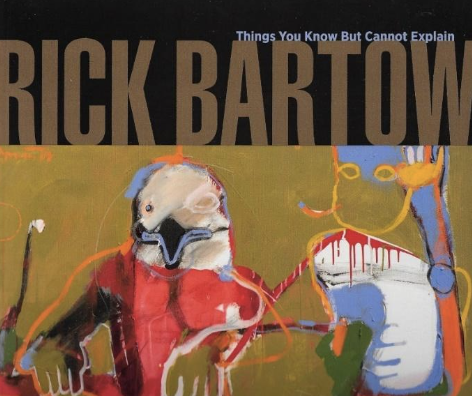
- “His art was the subject of over 100 solo exhibitions at museums and galleries, including the retrospective Things You Know But Cannot Explain, organized by the Jordan Schnitzer Museum of Art at the University of Oregon, and accompanied with a fully illustrated monograph.”
- “He created sculptures, paintings, drawings, and prints over the course of his nearly 40-year career as an artist. He often depicted figures in transformation, humans becoming all kinds of animals and birds- crows, kestrels, hawks, dogs, coyotes, bears, bulls. His works show Indian leaders, references to dance and ceremony, artists and writers he admired, flowers, self-portraits.”
- “Froelick Gallery began representing him upon its inception in 1995 and continues to represent his estate. He lived in Newport, Oregon throughout his life.” Source: artist estate
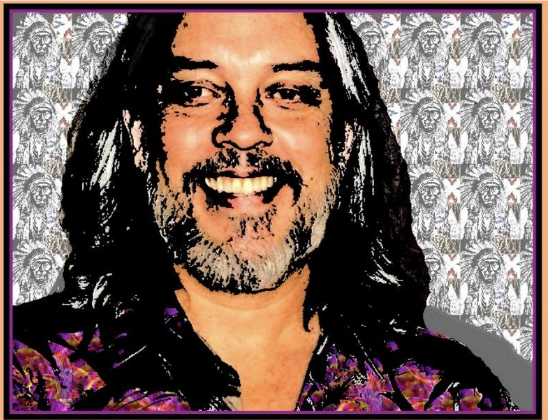
Gary Ogan
Cherokee Nation
Gary Ogan is a veteran of more than 50 years in the music business and a citizen of the Cherokee Nation.
It’s Only Water – The Gary Ogan Band
- Gary Ogan is a veteran of more than 50 years in the music business and a citizen of the Cherokee Nation.
- He is a prolific songwriter and multi-instrumentalist who performs his own songs on guitars, drums, keyboards, bass and vocals.
- Gary writes, arranges, records, engineers and produces albums where he plays all the instruments and sings all of the vocals. His skills in all of these areas have earned him recognition in the Oregon Music Hall of Fame and keep him in demand by other artists for their own recording projects.
- Gary recently self-published his e-book titled Pass it Down. Its 18 chapters contain lyrics and links to some 300 of the songs he’s written throughout his career—so far.
- When he was living in Nashville, Tennessee, writing songs for Sony Music, Sony published 60 of his songs.
- Gary was a recording and touring artist, writer and producer at Warner Records, a recording, touring artist and writer at Elektra Entertainment, and when Leon Russell launched his record label Paradise Records, Gary Ogan was the first artist he signed.
- Gary performed, wrote, recorded and produced with Leon during his time at Paradise.
Jim Pepper (1941-1992)
Kaw Nation/Muskogee Creek
“Jim Pepper’s music represents something that this museum has stood for from the very beginning. That is the wonderful connectedness between past and present, the gift of being able to move into media and forms of media that is not necessarily ours and making them ours in various powerful and important ways.” – Rick West, Executive Director, National Museum of the American Indian, 2007.
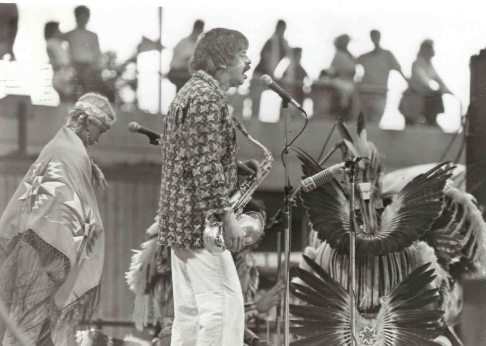
Custer Gets It – Jim Pepper
- “Jim Pepper’s music represents something that this museum has stood for from the very beginning. That is the wonderful connectedness between past and present, the gift of being able to move into media and forms of media that is not necessarily ours and making them ours in various powerful and important ways.” – Rick West, Executive Director, National Museum of the American Indian, 2007.
- Jim Pepper (Kaw/Muskogee Creek) was a self-taught virtuoso on tenor and soprano saxophones and flute with prodigious improvisational skills.
- His singing voice had a soulful, Old Soul quality and he was a remarkable dancer.
- Remembered primarily as a jazz musician, his musical horizon was much broader than that, exploratory and forward-looking, but based deep in Indian Country traditions and styles.
- He was a citizen of the Kaw Nation through his father, Gilbert Pepper, and had Muskogee Creek ancestry through his mother, Floy Childers Pepper. His Kaw Indian name, Hunga-che-Ada, translates to “Flying Eagle.”
- Pepper carved a path with his tenor sax that took him to New York City in 1964, where he co-founded The Free Spirits, credited with being the first band in music history to record what became known as “jazz-rock fusion.” He was a pioneer, along with such greats as trumpeter Don Cherry (Choctaw), in developing what came to be categorized as “World music.”
- He incorporated avant-garde “free jazz” into his work, music with no tonal center, successfully merging all of these vocabularies with Native church and powwow music. And Pepper developed a unique sound on his horn that came to be described as his “eagle tone.”
- “Jim opened up a lot of doors to take people to places that they had never been before, and we all have to work to keep his legacy alive and open more doors for young people, to inspire them to live their lives creatively and make a contribution to the world while we are here the way Jim did.” – David Amram, 2013.
- “Pepper is remembered for his contributions to the jazz scene and the Native music scene, and for expanding perceptions and expectations for both genres.” – American Indian Community House, New York City

Lesson Closure
This lesson was to introduce students to a few artists/musicians from Oregon. This is not an exhaustive list and there are constantly more people creating art and music.
√ Distribute Exit Ticket #1
After this lesson, were there musicians and artists you had not heard about before?